


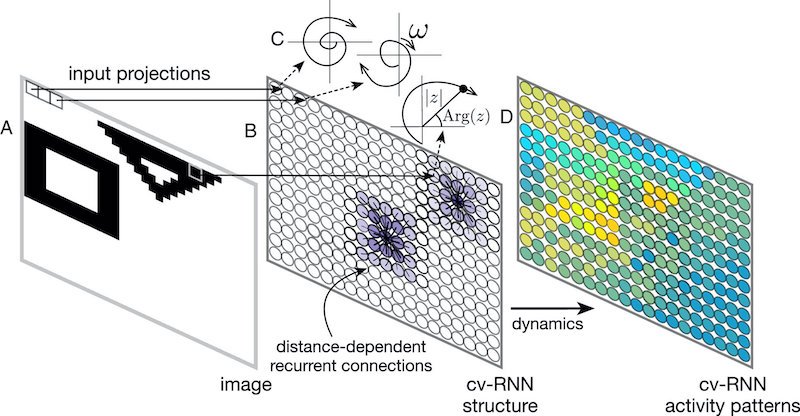
 Schematic representation of the cv-RNN. (A) Input image. Each pixel projects to one node in the cv-RNN. (B) Nodes in the cv-RNN are arranged into a 2D sheet, where recurrent connection weights (purple) decrease as a Gaussian with distance between nodes Eq. 4. (C) The activity of each node is described by a phase Arg ( 𝑧 ) and an amplitude | 𝑧 | in the complex plane. Inputs from image pixels modulate the natural frequency 𝜔 of the corresponding node. (D) Image inputs interact with the recurrent dynamics of the cv-RNN, to produce spatiotemporal patterns of activity in the network that can be used to segment images. Credit: Proceedings of the National Academy of Sciences (2025). DOI: 10.1073/pnas.2321319121
Jeff Renaud -- University of Western Ontario
Jan. 13, 2025
Western researchers have developed a novel technique using math to understand exactly how neural networks make decisions -- a widely recognized but poorly understood process in the field of machine learning.
Many of today's technologies, from digital assistants like Siri and ChatGPT to medical imaging and self-driving cars, are powered by machine learning. However, the neural networks -- computer models inspired by the human brain -- behind these machine learning systems have been difficult to understand, sometimes earning them the nickname "black boxes" among researchers.
"We create neural networks that can perform specific tasks, while also allowing us to solve the equations that govern the networks' activity," said Lyle Muller, mathematics professor and director of Western's Fields Lab for Network Science, part of the newly created Fields-Western Collaboration Centre. "This mathematical solution lets us 'open the black box' to understand precisely how the network does what it does."
The findings were published in the journal PNAS, in collaboration with international researchers including University of Amsterdam's machine learning research chair Max Welling.
(more)
