New Universe Baby Pictures. So Cute!
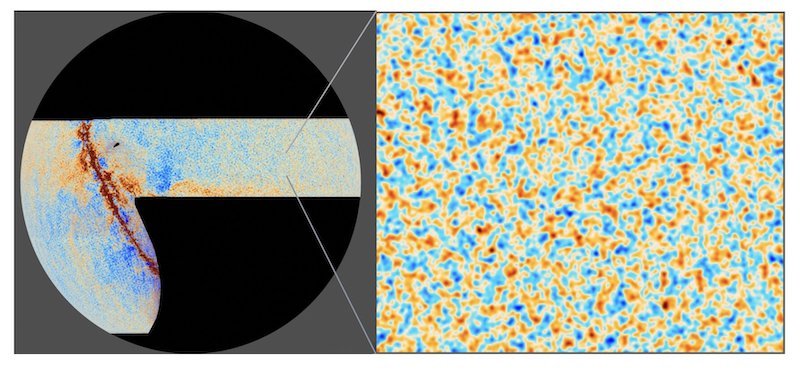 Research by the Atacama Cosmology Telescope collaboration has led to the clearest and most precise images yet of the universe's infancy, the cosmic microwave background radiation that was visible only 380,000 years after the Big Bang. This new sky map has put the standard model of cosmology through a rigorous new set of tests and show it to be remarkably robust. The new images of the early universe, which show both the intensity and polarization of the earliest light with unprecedented clarity, reveal the formation of ancient, consolidating clouds of hydrogen and helium that later developed into the first galaxies and stars. This piece of the new sky map that shows the vibration directions (or polarization) of the radiation. The zoom-in on the right is 10 degrees high. Polarized light vibrates in a particular direction; blue shows where the surrounding light's vibration directions are angled towards it, like spokes on a bicycle; orange shows places where the vibration directions circle around it. This new information reveals the motion of the ancient gases in the universe when it was less than half a million years old, pulled by the force of gravity in the first step toward forming galaxies. The red band comes from our closer-by Milky Way. Credit: ACT Collaboration; ESA/Planck Collaboration
March 18, 2025
New research by the Atacama Cosmology Telescope (ACT) collaboration has produced the clearest images yet of the universe's infancy -- the earliest cosmic time yet accessible to humans.
Measuring light that traveled for more than 13 billion years to reach a telescope high in the Chilean Andes, the new images reveal the universe when it was about 380,000 years old -- the equivalent of hours-old baby pictures of a now middle-aged cosmos.
"We are seeing the first steps towards making the earliest stars and galaxies," says Suzanne Staggs, director of ACT and Henry deWolf Smyth Professor of Physics at Princeton University. "And we're not just seeing light and dark, we're seeing the polarization of light in high resolution. That is a defining factor distinguishing ACT from Planck and other, earlier telescopes."
The new pictures of this background radiation, known as the cosmic microwave background (CMB), add higher definition to those observed more than a decade ago by the Planck space-based telescope. "ACT has five times the resolution of Planck, and greater sensitivity," says Sigurd Naess, a researcher at the University of Oslo and a lead author of one of several papers related to the project. "This means the faint polarization signal is now directly visible."
The polarization image reveals the detailed movement of the hydrogen and helium gas in the cosmic infancy. "Before, we got to see where things were, and now we also see how they're moving," says Staggs. "Like using tides to infer the presence of the moon, the movement tracked by the light's polarization tells us how strong the pull of gravity was in different parts of space."
The new results confirm a simple model of the universe and have ruled out a majority of competing alternatives, the research team says.
(more)
- CategoriesEdited | All Content | Education | Energy | Science | Technology | Americas | North America | South America | Space | News | News -- WNT Selected | Text | Images | Front Page Stories | Front Page News & Analysis
- Date rangeTuesday, March 18, 2025
- Last modifiedSaturday, March 22, 2025
