Three-pronged approach discerns qualities of quantum spin liquids -- Elizabeth Rosenthal, Oak Ridge National Laboratory
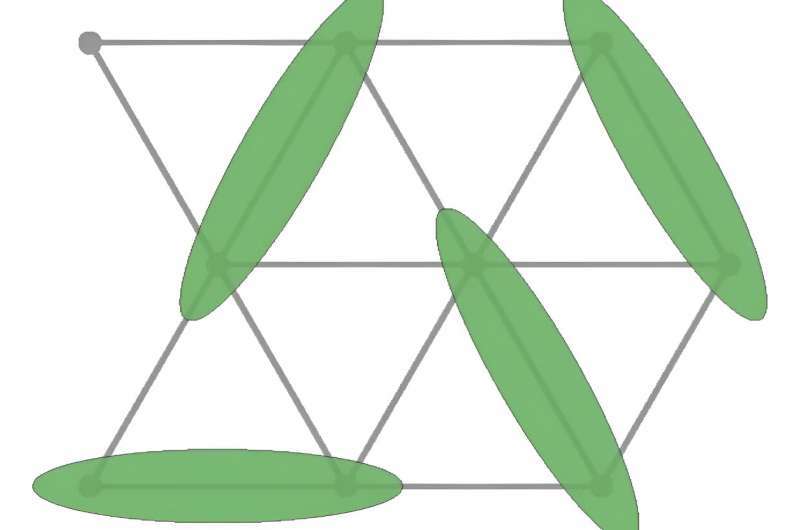 An illustration of the lattice examined by Phil Anderson in the early '70s. Shown as green ellipses, pairs of quantum particles fluctuated among multiple combinations to produce a spin liquid state. Credit: Allen Scheie/Los Alamos National Laboratory, U.S. Dept. of Energy
Elizabeth Rosenthal, Oak Ridge National Laboratory
Nov. 16, 2023
(Phys.org) -- In 1973, physicist Phil Anderson hypothesized that the quantum spin liquid, or QSL, state existed on some triangular lattices, but he lacked the tools to delve deeper.
Fifty years later, a team led by researchers associated with the Quantum Science Center headquartered at the Department of Energy's Oak Ridge National Laboratory has confirmed the presence of QSL behavior in a new material with this structure, KYbSe2.
QSLs—an unusual state of matter controlled by interactions among entangled, or intrinsically linked, magnetic atoms called spins—excel at stabilizing quantum mechanical activity in KYbSe2 and other delafossites. These materials are prized for their layered triangular lattices and promising properties that could contribute to the construction of high-quality superconductors and quantum computing components.
The paper, published in Nature Physics, features researchers from ORNL; Lawrence Berkeley National Laboratory; Los Alamos National Laboratory; SLAC National Accelerator Laboratory; the University of Tennessee, Knoxville; the University of Missouri; the University of Minnesota; Stanford University; and the Rosario Physics Institute.
"Researchers have studied the triangular lattice of various materials in search of QSL behavior," said QSC member and lead author Allen Scheie, a staff scientist at Los Alamos. "One advantage of this one is that we can swap out atoms easily to modify the material's properties without altering its structure, and this makes it pretty ideal from a scientific perspective."
(more)
- Categories
- Date rangeThursday, November 16, 2023
- Last modifiedSaturday, November 18, 2023
